
London strengthens position as Europe’s leading meetings destination
29 May 2026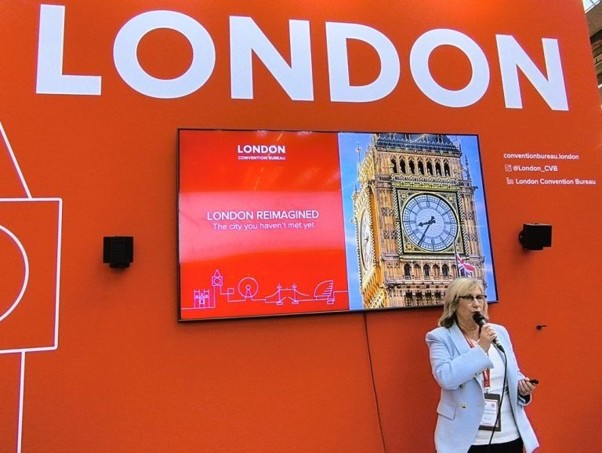
The recognition comes as London expands its meetings and events infrastructure with major investments in venues, hotels, transport, and entertainment districts. Returning to IMEX Frankfurt 2026, the London Convention Bureau was joined by 24 of the capital’s leading hotels, venues, destination management companies, and event service providers to showcase the city’s evolving business tourism offering.
The London Convention Bureau expects close to 80,000 delegates to visit the capital in 2026 through a wide range of international congresses and meetings. A particularly strong growth area has been medical and scientific events, with London continuing to attract some of Europe’s largest healthcare congresses.
Among the headline events this year is the European Alliance of Associations for Rheumatology (EULAR), taking place at Excel London in June and expected to attract more than 13,500 delegates from around 130 countries. The European Society of Human Reproduction and Embryology (ESHRE) will also return to Excel London in July for its 42nd Annual Meeting, bringing an estimated 12,000 delegates from 140 countries.
Earlier this year, London also hosted the 41st Annual Congress of the European Association of Urology (EAU), welcoming more than 12,000 healthcare professionals for Europe’s largest urology congress.
London’s long-term pipeline remains strong, with major congresses already secured for 2027 and 2028, while active bids are underway for events as far ahead as 2035.
The city’s appeal extends far beyond healthcare. Olympia’s new International Convention Centre (ICC) will host 1,500 international delegates for the 44th World Scout Conference in late 2027, while the International Association of Ports and Harbours (IAPH) will bring 700 delegates to the venue. Technology events continue to grow strongly as well, with Cisco confirming a new three-year agreement at Excel London that will bring more than 50,000 delegates to the capital. Other major tech gatherings include Databricks and SailPoint.
The International Trademark Association (INTA) has also selected London for its first-ever event in the city, reinforcing London’s status as a preferred destination for major global congresses and international collaboration.
Barbara Jamison-Woods, Head of Europe, Convention Bureau at London & Partners, said global organizations continue to choose London because of its mix of expertise, connectivity, and collaborative environment. During a presentation at IMEX, she highlighted the city’s world-class venues, international academic and professional networks, and ability to attract delegates from across the globe.
A major driver of London’s growth is the transformation of key districts across the city. One of the most ambitious projects is Olympia’s £1.3 billion redevelopment, which is turning the historic West London venue into a fully integrated entertainment, hospitality, and convention destination.
Central to the project is the new International Convention Centre, which will significantly expand London’s ability to host large-scale global gatherings. The redevelopment also includes two new hotels, extensive pedestrianized public spaces, restaurants, bars, entertainment venues, and a new theatre district.
Adam Pollington – Olympia Events, described the project as a defining new chapter for London’s global events industry, combining restored heritage halls with state-of-the-art event facilities, premium hospitality, and new entertainment experiences.
The Olympia estate now includes the newly opened Hyatt Regency London Olympia with more than 200 rooms and a CitizenM property with around 150 rooms. A new public realm featuring restaurants, bars, and cultural spaces is also opening this summer, alongside a new live music venue developed in partnership with British Airways. In 2027, Olympia will debut London’s first purpose-built theatre since 1976 through a partnership with Trafalgar Entertainment Group and the Shubert Organization.
Excel London is also expanding rapidly following a £220 million investment completed in late 2025, adding 25,000 square meters of new event space. The expansion strengthens Excel’s position at the centre of London’s business events ecosystem and is expected to attract an additional 2.5 million visitors to the Royal Docks area.
James Rees, Director of Excel London, said the investment has helped secure new international congresses and large corporate events for the city. Excel alone will host 10 major international association congresses this year, including the European Association of Urology event that brought 12,300 delegates from 132 countries to London.
Transport improvements continue to support London’s appeal. The Elizabeth Line now connects Heathrow Airport directly to Excel London in just 43 minutes, dramatically improving delegate access and visitor flows across the city.
London’s global accessibility remains one of its strongest advantages. The city is served by six international airports and extensive Eurostar rail links to Paris, Brussels, and Amsterdam, allowing delegates to travel efficiently and sustainably from across Europe.
The capital’s hospitality sector is also entering a new growth phase with several major hotel openings scheduled for 2026 and beyond. Waldorf Astoria Admiralty Arch is set to open in late 2026 with 100 luxury rooms overlooking The Mall and Trafalgar Square. The Other House Covent Garden will introduce a residential-style hospitality concept designed for extended stays and informal business gatherings, while Hyatt Regency London Olympia officially opens on July 6, 2026.
These properties join recent luxury arrivals including The Chancery Rosewood in Grosvenor Square, Six Senses London in Bayswater, and The Zetter Bloomsbury.
London officials also highlighted the city’s diversity of accommodation, culinary offerings, and cultural experiences. The capital now offers more than 160,000 hotel rooms across every category and price point, alongside 88 Michelin-starred restaurants representing cuisines from around the world.
Business event planners are increasingly looking for destinations that combine large-scale infrastructure with authentic local experiences, and London believes its mix of heritage, innovation, culture, and connectivity continues to give it a competitive edge in the global meetings market.